
Cosplay fabric without a yardage chart: a Sherlock Holmes example
Many cosplay patterns come without a fabric chart, and self-drafted ones never have one. This example uses FreeSewing's Carlton coat, which FreeSewing describes as a pattern for Sherlock Holmes cosplay, and the Holmes deerstalker. Every length below comes from a calculated layout you can download and recalculate.
The example and its sources
The coat is Carlton from FreeSewing, designed by Joost De Cock and Anneke Caramin and coded by Joost De Cock. FreeSewing describes it as a pattern for Sherlock Holmes cosplay. The hat is the Holmes deerstalker, designed by Erica Alcusa Sáez and coded by Erica Alcusa Sáez, bob and george the3rd. Both are open source under the MIT licence.
I exported both on 15 October 2026 from FreeSewing 4.10.2 with FreeSewing's sample measurements "cisMaleAdult42" (chest 110.5 cm, head 61.2 cm) and a 10 mm seam allowance. Your size gives different numbers, but you can work them out the same way.
I develop PatternNest, the layout tool used here. This article is not affiliated with FreeSewing.
What each material needs
| Material | Width | Pieces | Length |
|---|---|---|---|
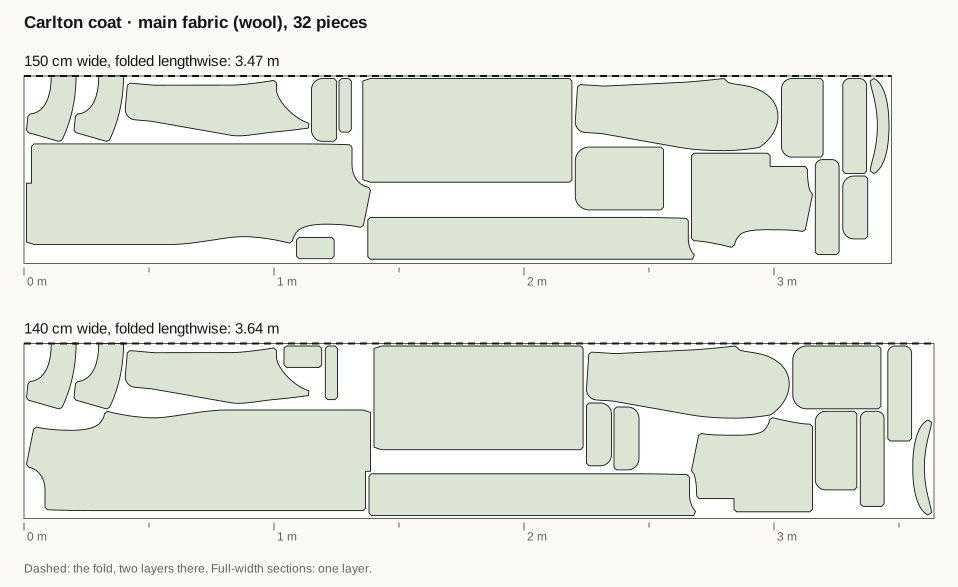
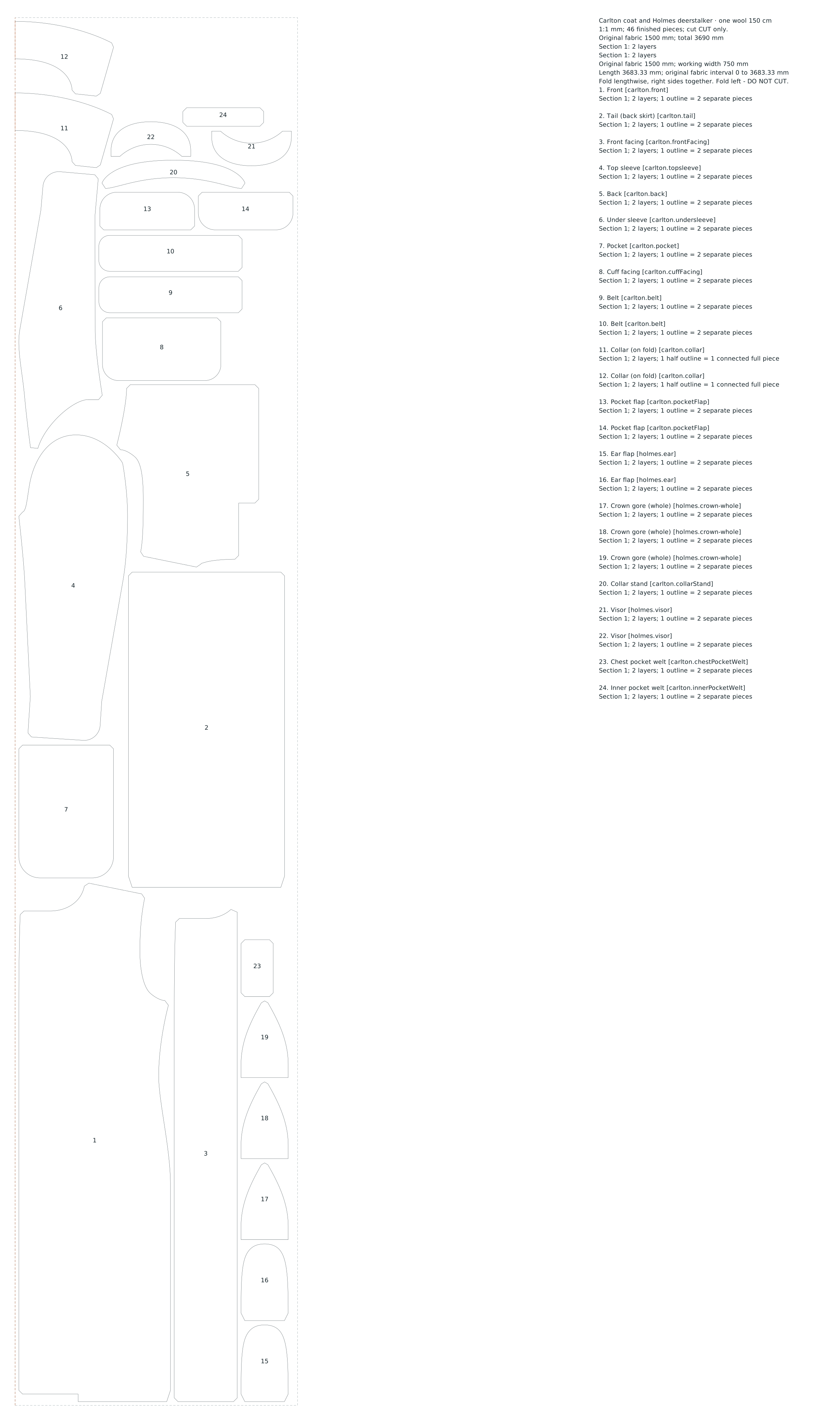
| Coat main fabric (wool) | 150 cm | 32 | 3.47 m |
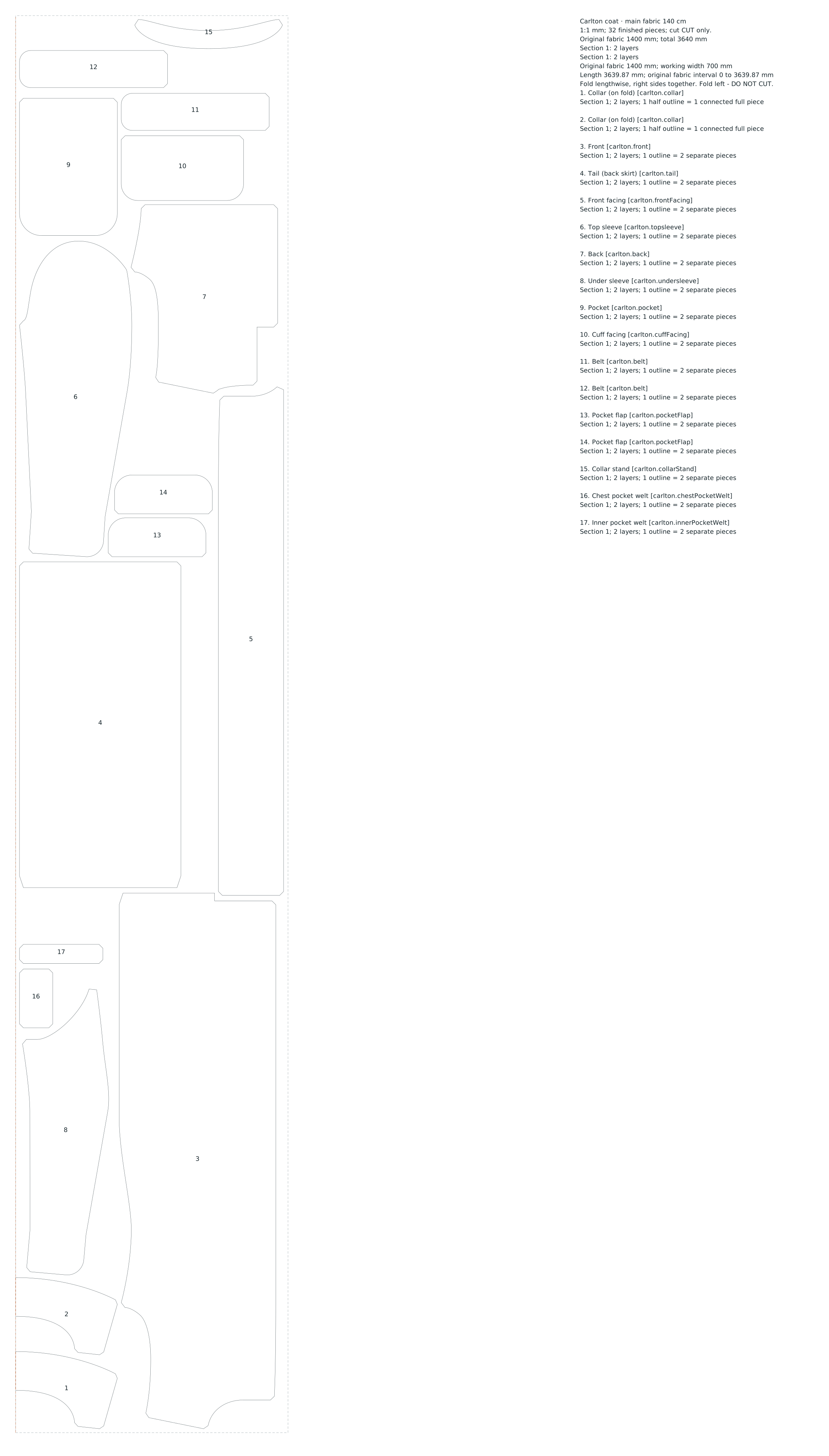
| Coat main fabric (wool) | 140 cm | 32 | 3.64 m |
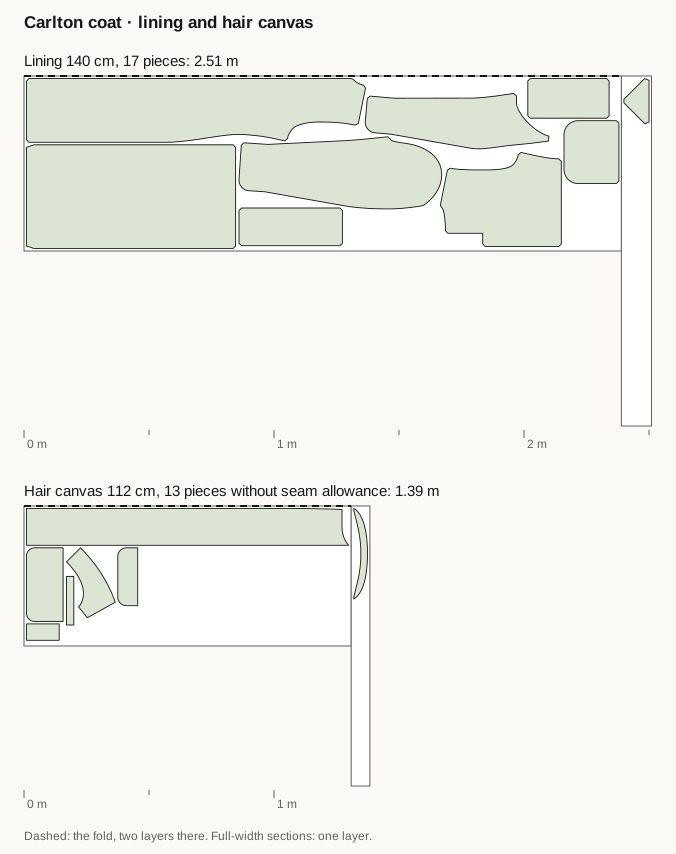
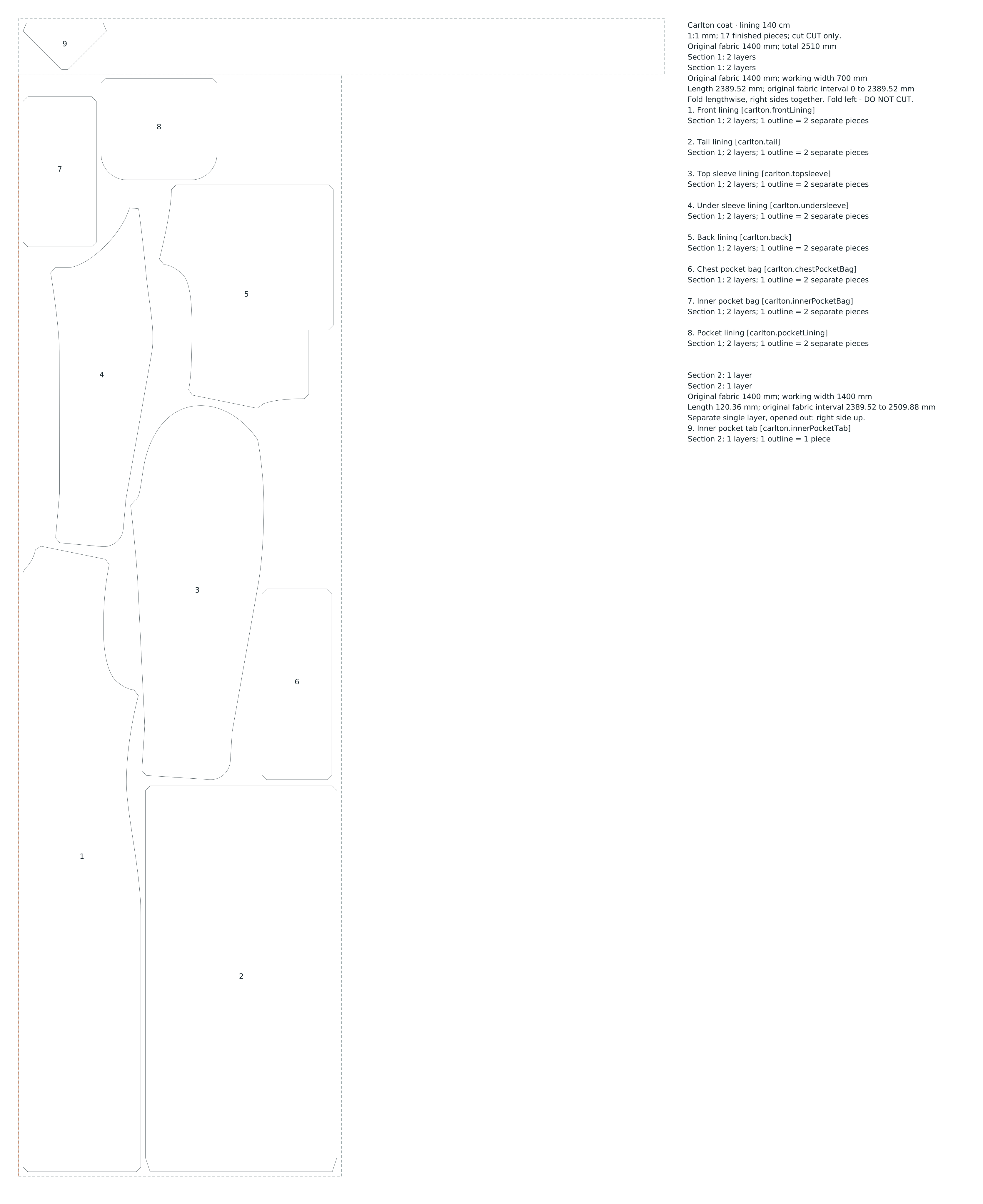
| Coat lining | 140 cm | 17 | 2.51 m |
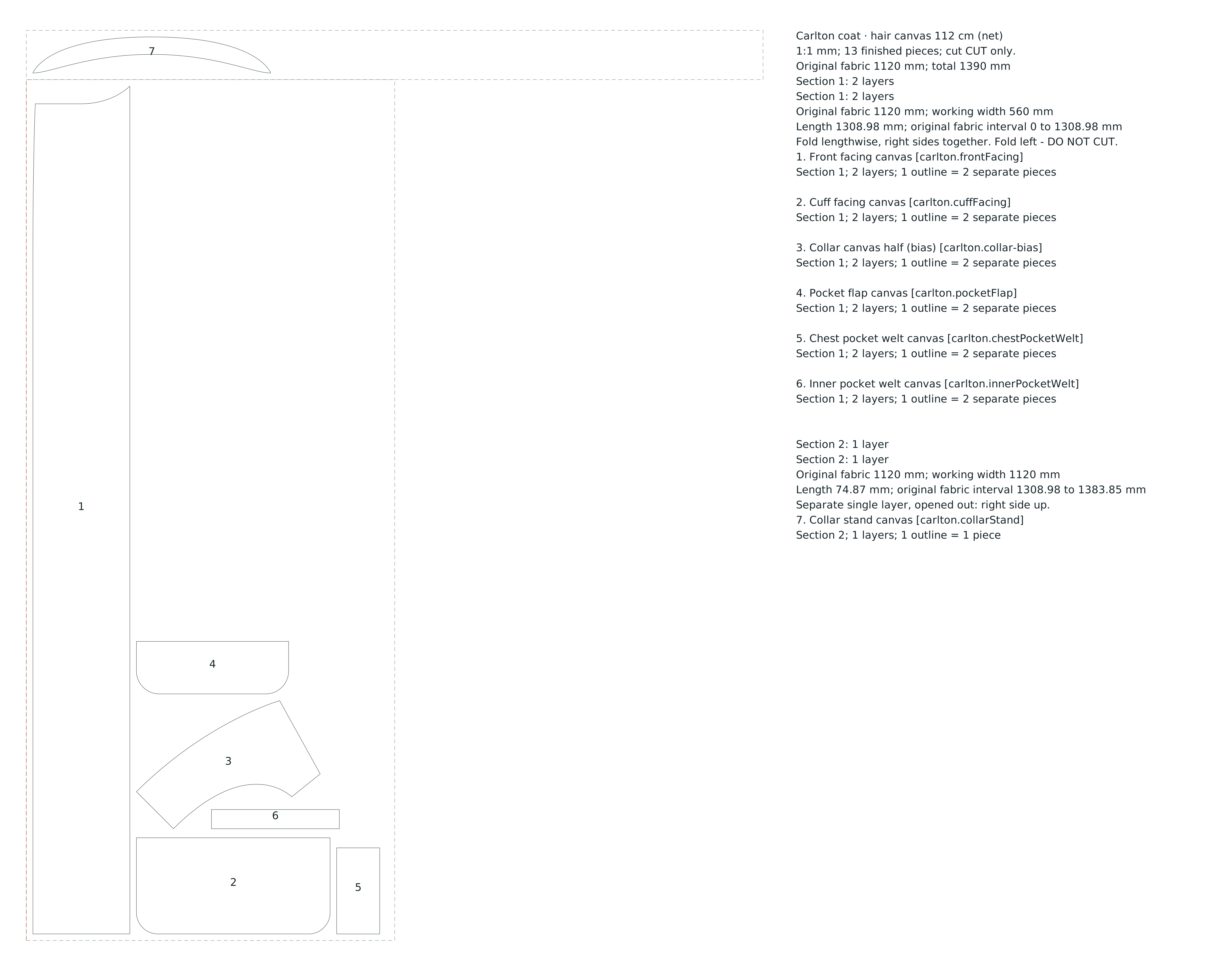
| Light hair canvas, cut without allowance | 112 cm | 13 | 1.39 m |
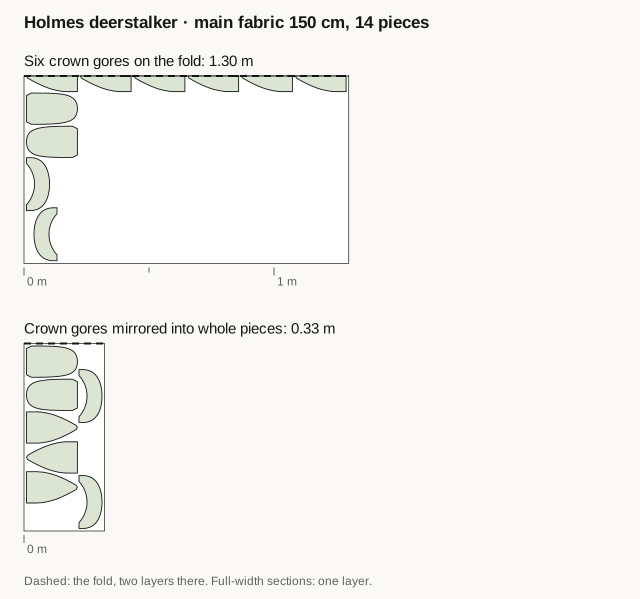
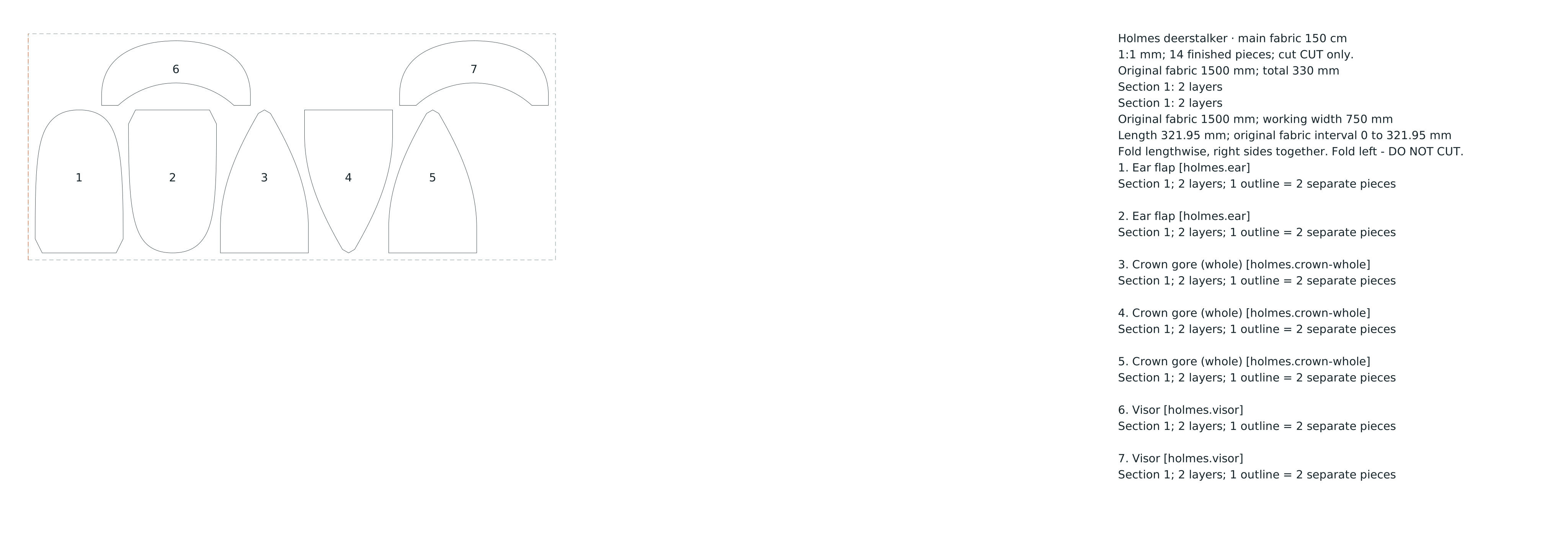
| Deerstalker main fabric | 150 cm | 14 | 0.33 m |
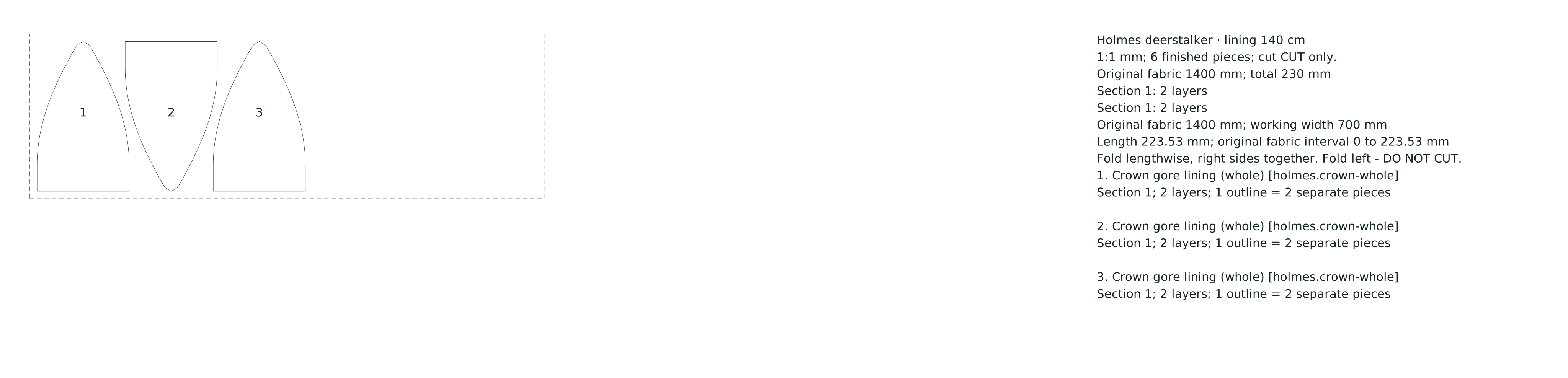
| Deerstalker lining | 140 cm | 6 | 0.23 m |
Every plan uses fabric folded lengthwise with the fold on the left, a 1 cm edge margin, a 1 cm gap between pieces and Standard effort. Pieces keep their grain and may only be turned by 180°. Each material has its own plan, because each comes in its own width.
FreeSewing's Carlton page estimates 5 to 6 m of main fabric, 3.5 to 4 m of lining and 0.75 to 1 m of sleeve lining, and about 0.5 m each for the hat. Those are rough figures meant to cover every size and width. The layouts here are for one size on fixed widths, so the numbers don't compare directly. They show where the fabric goes. For your own size, calculate your own layout.
The layouts
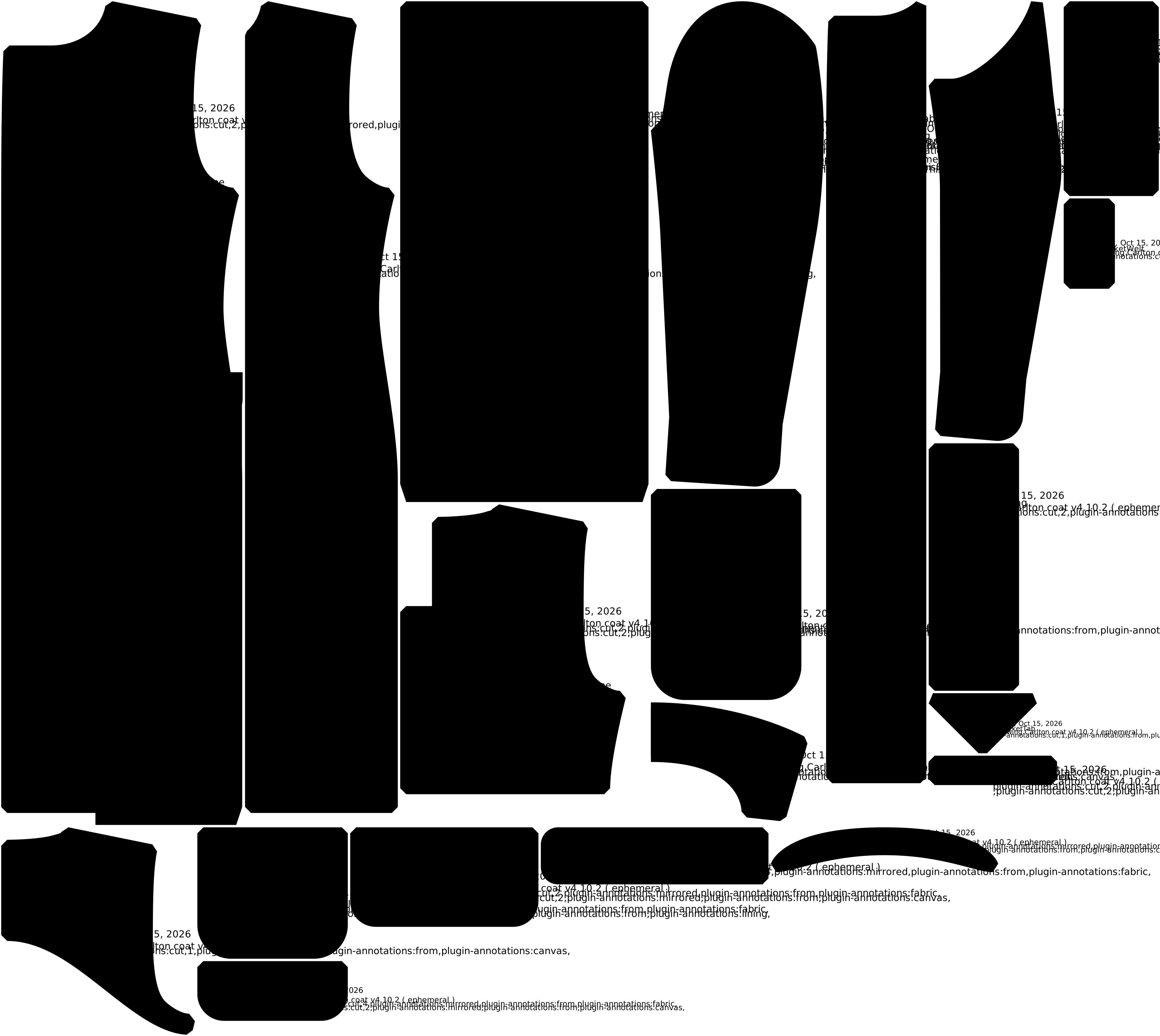
The drawings lie on their side: the fabric length runs from left to right, the fold is the dashed edge. Each outline stands for two pieces cut through both layers, except the collars on the fold, which open into one whole collar each.
The cutting list, checked against FreeSewing
| Material | Pieces |
|---|---|
| Main fabric, 32 | front 2, front facing 2, back 2, tail 2, top sleeve 2, under sleeve 2, belt 4, collar stand 2, collar 2 (each on the fold), cuff facing 2, pocket 2, pocket flap 4, chest pocket welt 2, inner pocket welt 2 |
| Lining, 17 | front lining 2, back 2, tail 2, top sleeve 2, under sleeve 2, inner pocket bag 2, inner pocket tab 1, pocket lining 2, chest pocket bag 2 |
| Light hair canvas, 13 | front facing 2, collar stand 1, collar 2 halves on the bias, cuff facing 2, pocket flap 2, chest pocket welt 2, inner pocket welt 2 |
| Deerstalker | main fabric: crown gore 6, visor 4, ear flap 4; lining: crown gore 6; visor insert 2 from a stiff material |
FreeSewing stores a cut list inside each pattern. For Carlton it differs from the cutting instructions in the documentation in four places: it counts the under sleeve twice, lists the chest pocket bag, pocket lining and inner pocket tab as main fabric instead of lining, and has no canvas for the chest pocket welt. In the source code, two pieces inherit cuts on top of their own and three pass their material in a way the cut list ignores. The plans follow the documentation.
The documentation allows both collars on the fold or the under collar on the bias; these plans cut both on the fold. The canvas collar is two halves on the bias, so the half collar was turned by 45° before calculating. The heavy hair canvas pieces (front shoulder, chest canvas, back shoulder) are traced from the front and back as the instructions describe and are not in these plans. The same goes for the back stay, which appears in the pattern's cut list but not in the documentation.
Working it out for your own costume
- Count finished pieces, not pattern pieces. A pair is two pieces, "cut 4" is two pairs, and a piece cut on the fold becomes one whole piece.
- Make one plan per material. Outer fabric, lining and interfacing each have their own width and their own length. If the hat uses the coat wool, put both into one plan: here 3.69 m instead of 3.47 m plus 0.33 m.
- Check nap and pile. Velvet, corduroy and many coat wools need every piece pointing the same way. Set the pieces to one-way (nap) and calculate again rather than adding a percentage. For this coat it made no difference (3.47 m either way). Other patterns can need more.
- Watch small pieces marked "on the fold". Folded lengthwise, the fabric has one fold line. Six crown gores along it needed 1.30 m; mirrored into whole pieces they fit into 0.33 m. Mirror such pieces in your drawing program before importing, or start from the prepared project.
- A single piece in folded fabric gets its own single-layer section. The one inner pocket tab added 12 cm to the lining. Cut it twice and keep the spare, and the lining needs 2.39 m.
- Keep the reserve separate. Pre-washing wool, cutting mistakes and pattern matching all need extra. Add it on top of the layout length and note it as its own number.
FreeSewing files in PatternNest
Export the pattern from FreeSewing as SVG with seam allowance. PatternNest uses the allowance outline as the cutting line, including allowances that FreeSewing draws open along a fold. Check the import notes. A piece listed as "imported without seam allowance" uses its seam line, and the fabric length comes out too short for it.
The import does not read FreeSewing's cut list. Set quantities, mirrored pairs and fold edges yourself from the documentation, as in the table above. A piece that FreeSewing draws with its fold across, like the deerstalker crown, needs one "Turn 90°" first, because in the layout the drawing's vertical direction runs along the selvage.
Download and recalculate
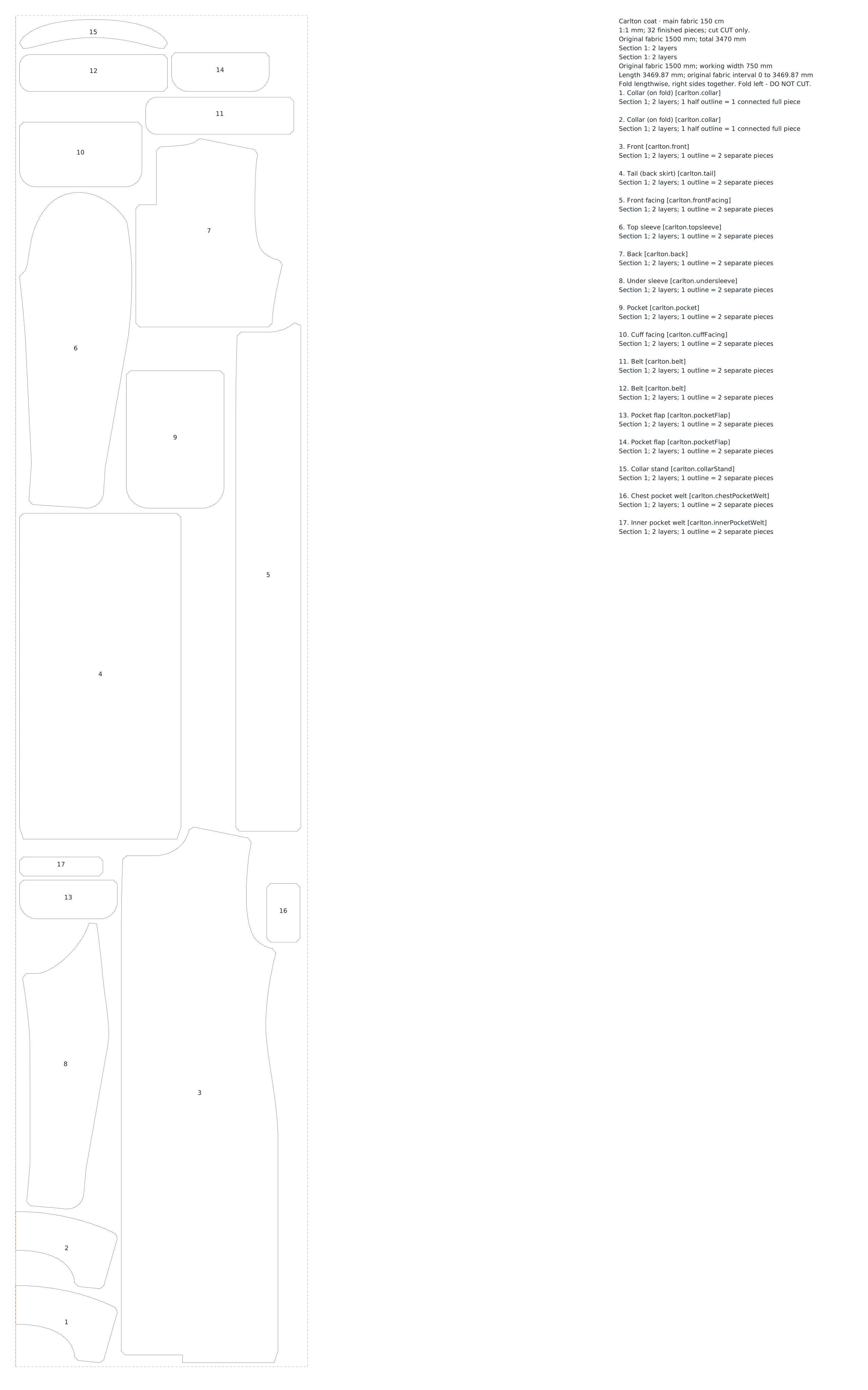
The .pnest files hold the pieces and settings, not a finished layout. Open one in PatternNest with Open .pnest and press Calculate layout. The SVG files are the full 1:1 cutting diagrams with a numbered piece list.
- Coat, main fabric 150 cm: project (.pnest)
- Coat, main fabric 150 cm: cutting diagram (SVG)
- Coat, main fabric 140 cm: project (.pnest)
- Coat, main fabric 140 cm: cutting diagram (SVG)
- Coat and hat from one wool, 150 cm: project (.pnest)
- Coat and hat from one wool, 150 cm: cutting diagram (SVG)
- Coat, lining 140 cm: project (.pnest)
- Coat, lining 140 cm: cutting diagram (SVG)
- Coat, hair canvas 112 cm: project (.pnest)
- Coat, hair canvas 112 cm: cutting diagram (SVG)
- Hat, main fabric 150 cm: project (.pnest)
- Hat, main fabric 150 cm: cutting diagram (SVG)
- Hat, lining 140 cm: project (.pnest)
- Hat, lining 140 cm: cutting diagram (SVG)
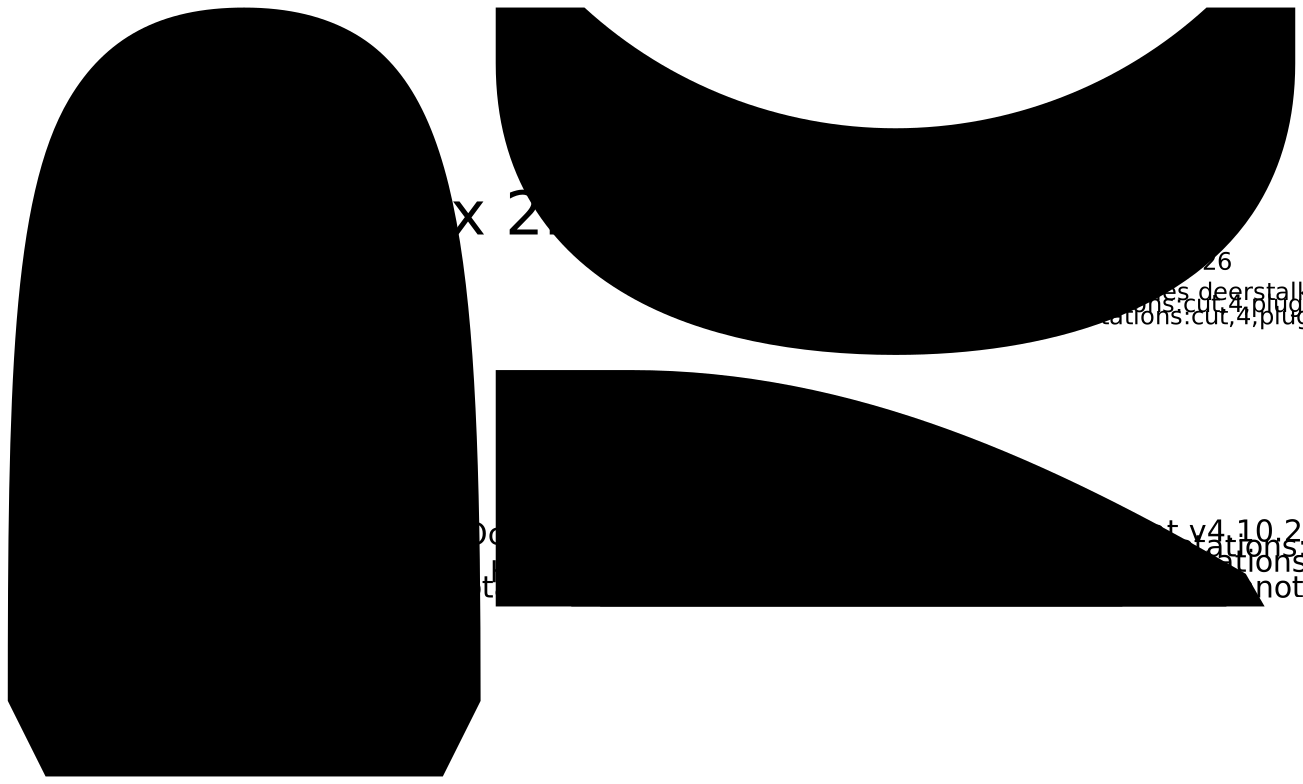
- Hat crown and visor: 10 pieces to try for free (.pnest)
- FreeSewing Carlton, size cisMaleAdult42, 10 mm seam allowance (SVG)
- FreeSewing Holmes, size cisMaleAdult42, 10 mm seam allowance (SVG)
- FreeSewing MIT licence
- Carlton at FreeSewing: fabric, cutting, instructions
- Holmes at FreeSewing: fabric, cutting, seam allowances
Check before cutting
The diagrams leave out notches, grainline arrows and labels; keep the FreeSewing print for those. Hem allowances are whatever FreeSewing draws.
For the deerstalker, the Holmes documentation recommends 6 mm allowance on the crown sides, 13 mm at the bottom and a test crown before cutting the real fabric. These plans use 10 mm everywhere. The visor also needs a stiff insert, such as buckram, plastic sheet or foam, cut without allowance.
Credits
FreeSewing Carlton: design Joost De Cock and Anneke Caramin, code Joost De Cock. FreeSewing Holmes: design Erica Alcusa Sáez, code Erica Alcusa Sáez, bob and george the3rd. Both MIT licensed. Layout calculations and article: Cayan / Madegrain.