
How much fabric for a shirt or blouse
How much fabric a shirt or blouse needs depends on the fabric width, the sleeves and whether the fabric has a nap or a plaid. Here a men's shirt and a blouse from free FreeSewing patterns are computed on four widths, with long and short sleeves, single layer and folded.
The numbers at a glance
All lengths for 150 cm wide fabric, with 1 cm seam allowance, pieces any way:
| 150 cm wide | Single layer | Folded lengthwise |
|---|---|---|
| Shirt, long sleeves | 1.61 m | 2.06 m |
| Shirt, short sleeves | 1.27 m | 1.77 m |
| Blouse, long sleeves | 1.28 m | 1.40 m |
| Blouse, short sleeves | 1.07 m | 1.40 m |
In a single layer each of these patterns needs less fabric than folded lengthwise, the long-sleeved shirt 45 cm less. When you choose Folded lengthwise in PatternNest, it also computes the single layer, takes it when it needs less fabric and tells you so.
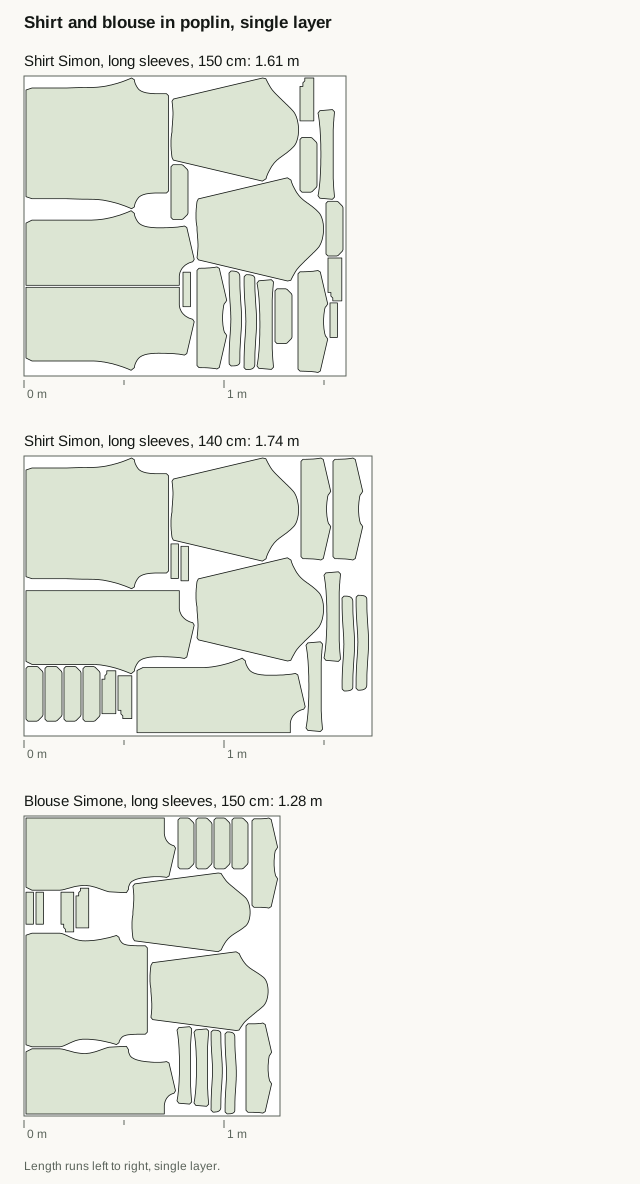
On 140 cm the long-sleeved shirt needs 1.74 m, on 110 cm 2.28 m. The long-sleeved blouse needs 1.74 m on 110 cm.
The patterns and the measurements
I computed two free patterns from FreeSewing: the men's shirt Simon and the blouse Simone, which is Simon with a full bust adjustment. Joost De Cock designed and coded both, both are under the MIT licence. Exported with FreeSewing 4.10.2 and 1 cm seam allowance.
The shirt is drafted with FreeSewing's measurement set cisMaleAdult42, chest 110.5 cm. The blouse with cisFemaleAdult36, chest 97.9 cm. For two sizes in one layout the shirt in cisMaleAdult36 joins, chest 94.7 cm.
Each piece is cut as often as FreeSewing's cut list says. The long-sleeved shirt has 19: the back on the fold, right and left front with the button band cut on, two sleeves, two yokes, two collars, two collar stands, four cuffs and two pairs of sleeve plackets. With short sleeves the cuffs and plackets go, leaving 11. Interfacing for collar, stand and cuffs is not counted.
Four fabric widths, single layer and folded
Poplin and shirting usually come 140 to 150 cm wide, cotton for blouses also 110 cm. In a single layer, the back opened out:
| Single layer | 110 cm | 140 cm | 150 cm | 160 cm |
|---|---|---|---|---|
| Shirt, long sleeves | 2.28 m | 1.74 m | 1.61 m | 1.55 m |
| Shirt, short sleeves | 1.82 m | 1.39 m | 1.27 m | 1.28 m |
| Blouse, long sleeves | 1.74 m | 1.37 m | 1.28 m | 1.22 m |
| Blouse, short sleeves | 1.50 m | 1.11 m | 1.07 m | 1.00 m |
Folded lengthwise, selvage to selvage, the way the fold planner lays the pieces:
| Folded | 110 cm | 140 cm | 150 cm | 160 cm |
|---|---|---|---|---|
| Shirt, long sleeves | 2.55 m | 2.12 m | 2.06 m | 1.87 m |
| Shirt, short sleeves | 2.23 m | 1.79 m | 1.77 m | 1.61 m |
| Blouse, long sleeves | 2.11 m | 1.40 m | 1.40 m | 1.40 m |
| Blouse, short sleeves | 1.81 m | 1.40 m | 1.40 m | 1.40 m |
From 150 to 140 cm the long-sleeved shirt needs 13 cm more, on 110 cm 67 cm more. For the short-sleeved shirt 160 cm gains nothing: PatternNest lays it out at 1.28 m there, 1 cm more than on 150 cm. A layout for 150 cm also fits 160 cm wide fabric, so set 150 cm in that case.
In a single layer PatternNest spreads the pieces over the full width and turns them against each other, and the small pieces fill the gaps. Folded, every piece lies on both layers, and what stays free next to a large piece stays free on both. Cutting folded is quicker; a single layer saves fabric here.
Flannel, corduroy and velvet with a nap
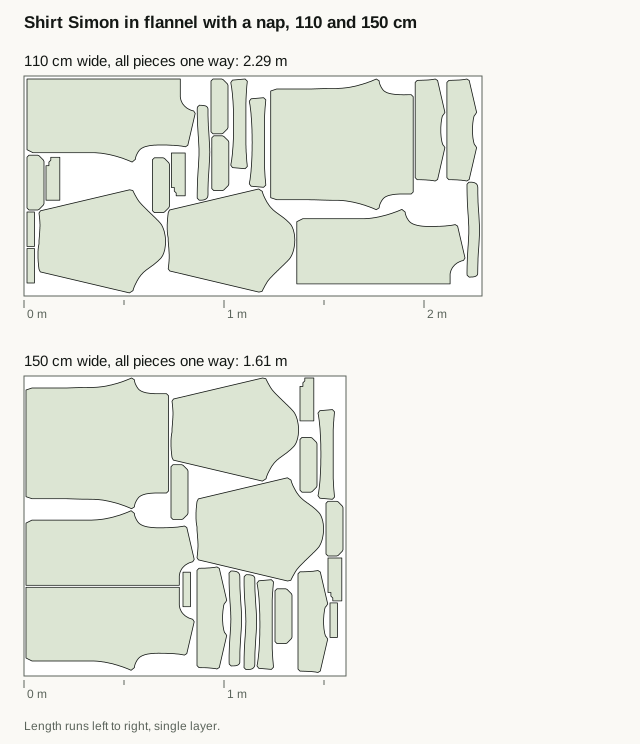
Brushed fabrics like flannel often have a nap, corduroy and velvet always do. Then all pieces must lie the same way round. Computed in a single layer:
| Width | Shirt | Shirt, nap | Blouse | Blouse, nap |
|---|---|---|---|---|
| 110 cm | 2.28 m | 2.29 m | 1.74 m | 1.77 m |
| 140 cm | 1.74 m | 1.74 m | 1.37 m | 1.39 m |
| 150 cm | 1.61 m | 1.61 m | 1.28 m | 1.28 m |
| 160 cm | 1.55 m | 1.55 m | 1.22 m | 1.22 m |
The nap costs at most 1 cm for the long-sleeved shirt and at most 3 cm for the long-sleeved blouse. On 150 and 160 cm it costs nothing for either.
Plaid flannel shirt with pattern matching
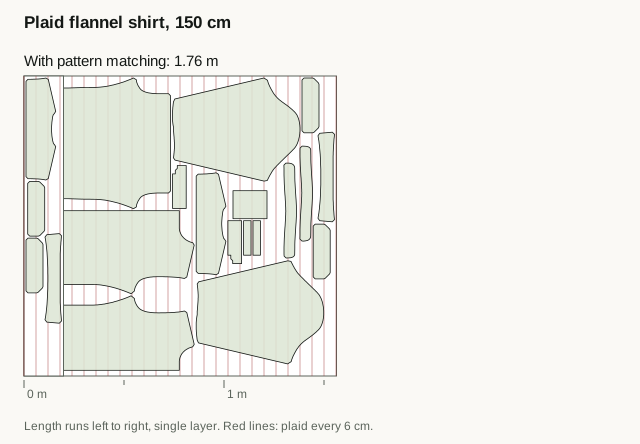
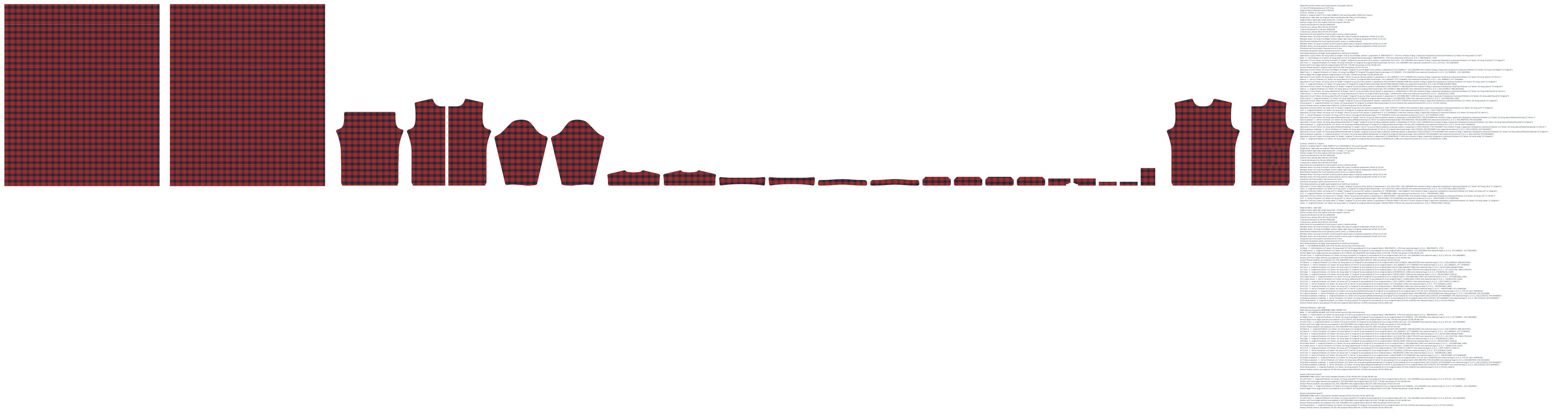
On a plaid shirt the cross lines at the front should sit at the same height when the shirt is buttoned, and the chest pocket should disappear into the plaid. For that I included PatternNest's pattern matching: plaid with a 6 cm repeat in length and width, all pieces one way, plus a chest pocket cut 14 by 17 cm. Two rules: the front edges of both fronts end on the same cross line at the bottom, and the centre of the pocket sits on the same plaid point as its place on the left front.
| Width | Without matching | Plaid matched |
|---|---|---|
| 110 cm | 2.35 m | 2.37 m |
| 140 cm | 1.75 m | 1.85 m |
| 150 cm | 1.63 m | 1.76 m |
| 160 cm | 1.55 m | 1.68 m |
On 150 cm the plaid shirt needs 1.76 m instead of 1.63 m without matching, on 140 cm 1.85 m instead of 1.75 m.
A plaid with another repeat gives other numbers. The plaid shirt download contains the settings; change the repeat to your fabric under Fabric pattern.
Two shirts in one layout
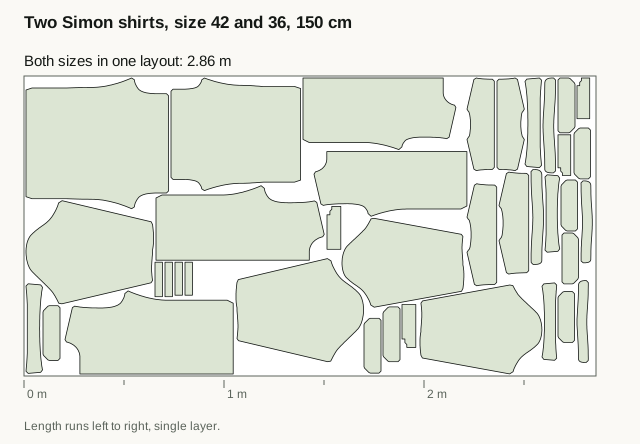
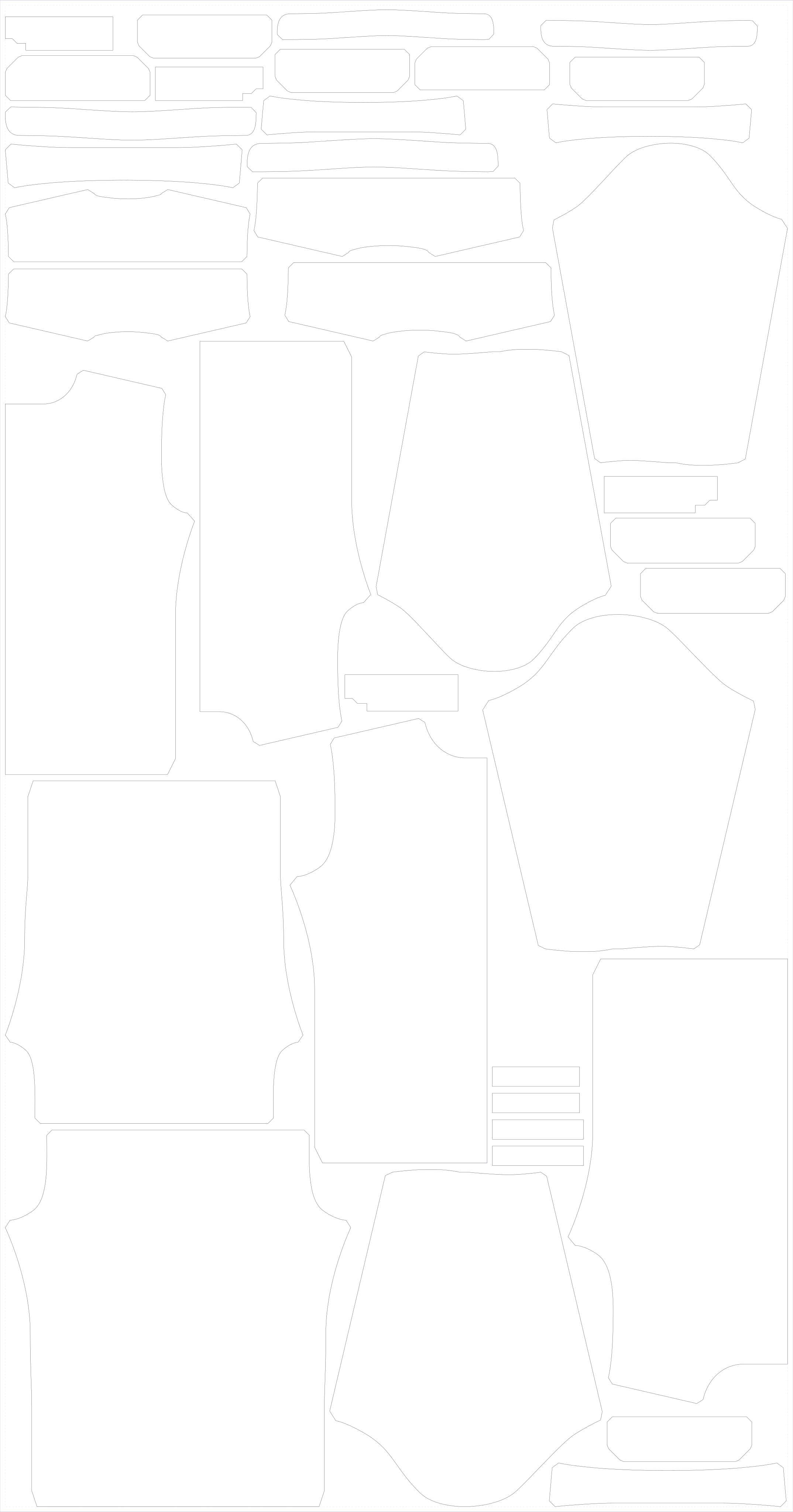
If two people need a shirt from the same fabric, put both sizes into one project. Computed for size 42 and 36 with long sleeves, each as its own file, single layer:
| Width | Size 42 | Size 36 | Together |
|---|---|---|---|
| 110 cm | 2.28 m | 1.78 m | 3.91 m |
| 140 cm | 1.74 m | 1.45 m | 3.12 m |
| 150 cm | 1.61 m | 1.35 m | 2.86 m |
| 160 cm | 1.55 m | 1.29 m | 2.72 m |
On 150 cm both together need 2.86 m, separately 1.61 m and 1.35 m. Together that is 10 cm less.
When the sizes come into the project as two files, PatternNest also lays out each file on its own and puts the layouts one after the other when that is shorter. So together is never longer than separately, with pattern matching too.
How to compute your own shirt
- Export the pattern in your size with seam allowance, as SVG, DXF or vector PDF. For two sizes, each as its own file.
- Prewash the fabric, cotton and flannel often shrink. Then measure the usable width from selvage to selvage.
- Open PatternNest and pick every file that comes from this fabric with Choose files… under Pattern pieces. Set each piece's quantity from your pattern's cut list, mirrored pieces with Cut as pair (mirrored).
- If the fabric has a nap or a one-way print, set the direction of every piece to one-way (nap).
- Choose the width and Single layer and click Calculate layout. PatternNest opens the back on the fold by itself.
- For plaid, set the repeat under Fabric pattern and use Match pattern to say which points should sit on one line.
Download and recompute
The .pnest projects hold pieces and settings, not a finished layout. Open them in PatternNest with Open .pnest and click Calculate layout. They are set to Single layer. The SVG files are layouts at 1:1 scale, as PatternNest exports them. The pieces are outlines with seam allowance for computing, without markings and without instructions. To sew, get Simon or Simone in your measurements from FreeSewing.
- Shirt, long sleeves, 150 cm: project (.pnest)
- Shirt, long sleeves, 140 cm: project (.pnest)
- Shirt, short sleeves, 150 cm: project (.pnest)
- Blouse, long sleeves, 150 cm: project (.pnest)
- Blouse, short sleeves, 150 cm: project (.pnest)
- Shirt with nap, 110 cm: project (.pnest)
- Plaid shirt with pattern matching, 150 cm: project (.pnest)
- Two shirts, size 42 and 36, 150 cm: project (.pnest)
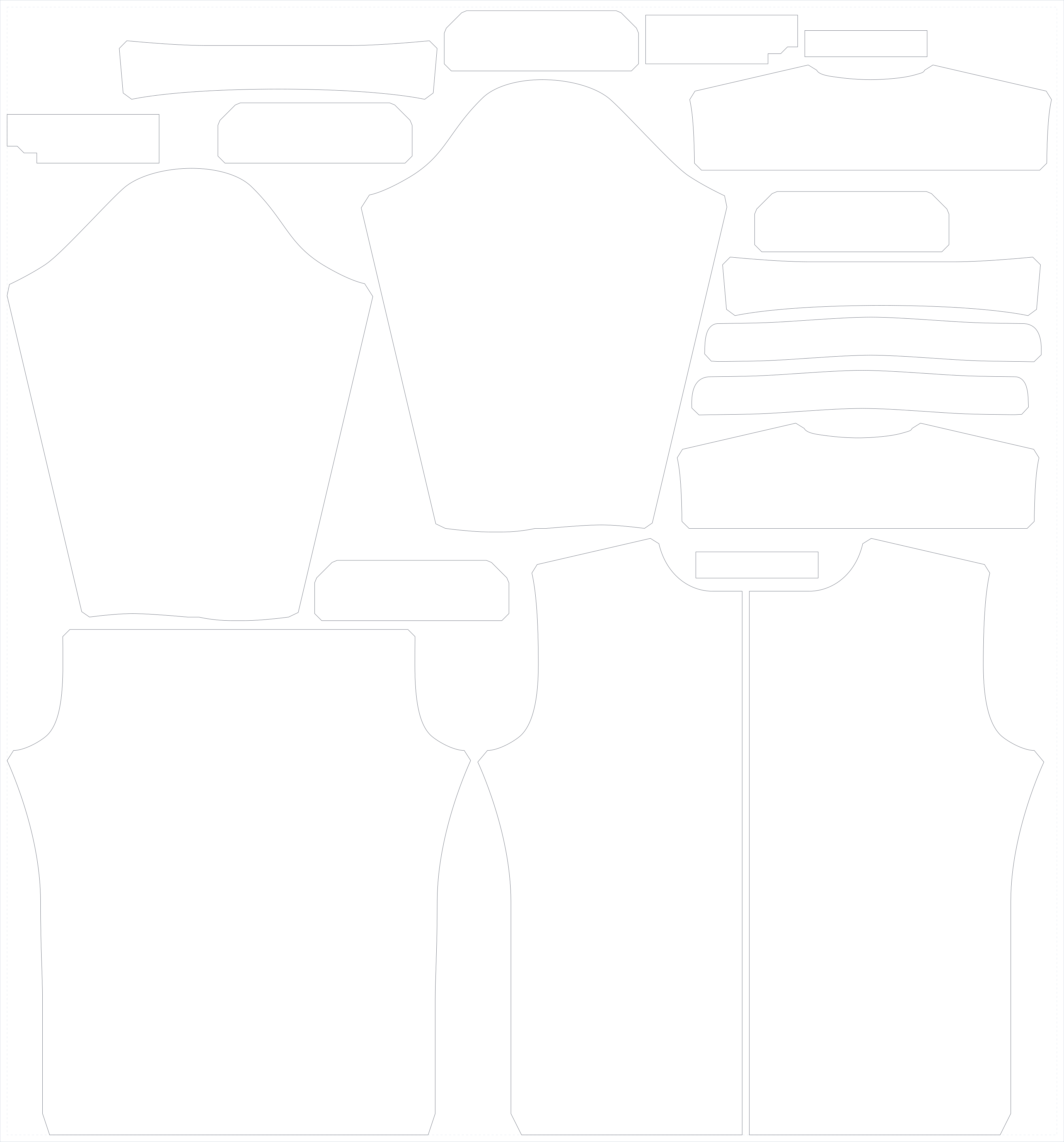
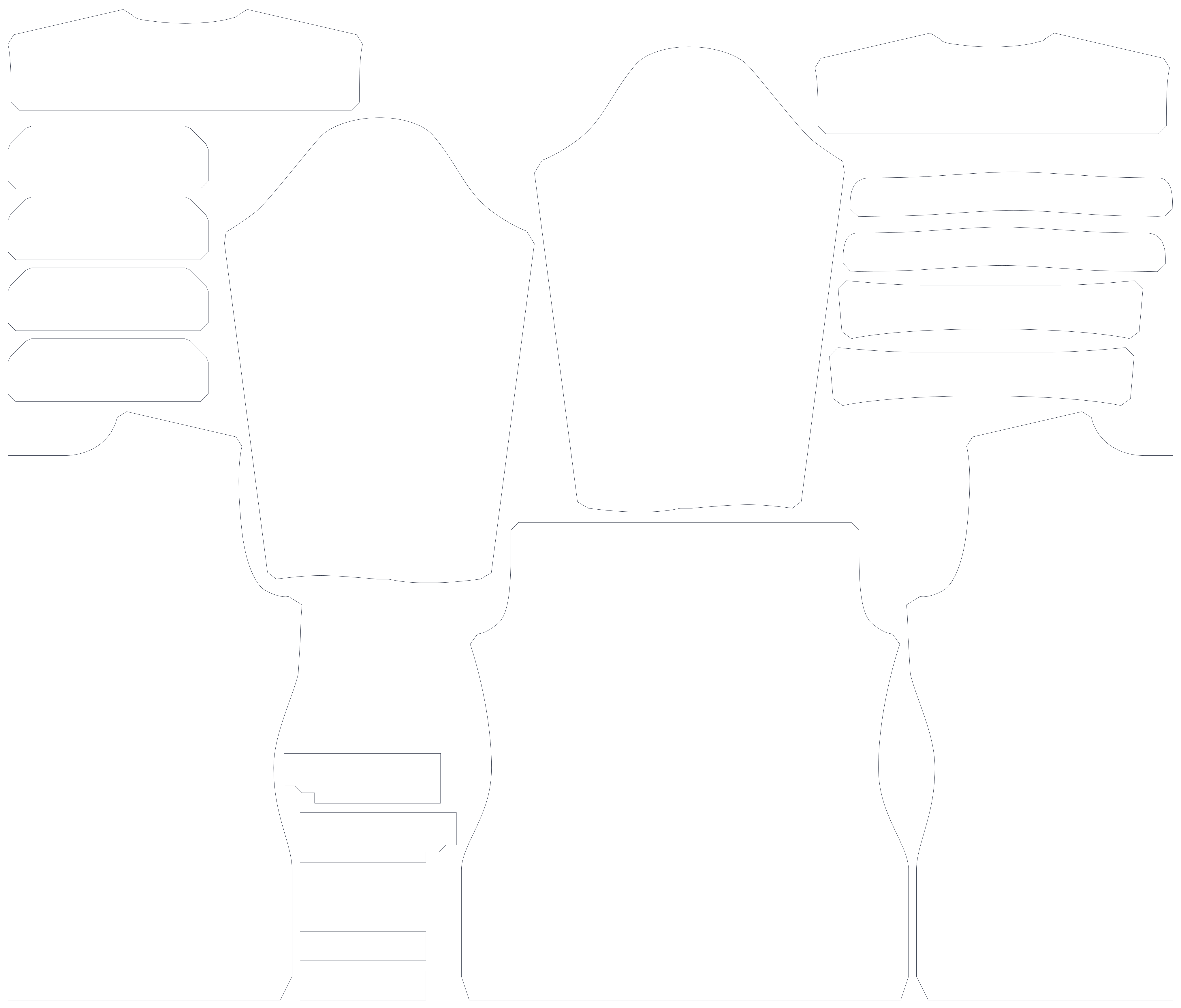
- Shirt, long sleeves, 150 cm: cutting layout (SVG)
- Blouse, long sleeves, 150 cm: cutting layout (SVG)
- Plaid shirt, 150 cm: cutting layout with plaid (SVG)
- Two shirts, 150 cm: cutting layout (SVG)
- FreeSewing MIT licence (text)
How the numbers are checked
Every layout passed PatternNest's check on the real outlines: no overlap, at least 1 cm spacing, everything on the fabric. On top of that come 555 cross-checks: narrower fabric is never shorter than wider except for the one centimetre of the short-sleeved shirt above, one way never shorter than any way, plaid matched never shorter than without matching, two shirts together never longer than separately, and no length is below the pieces' area divided by the width. For the single-layer layouts PatternNest's nesting ran to its end and the final result counted. Computed with the version of PatternNest that went online on 12 November 2026.
Further reading
What a nap costs for other patterns is in One-way fabric. How far a conversion between widths can be off is shown in Fabric width conversion. A hoodie on four widths is in Hoodie fabric, pants and top for the whole family in Pajama fabric. How to lay out pieces without software is in Pattern layout.
The shirt with plaid and horizontal stripes from 3 to 12 cm repeat: How much extra fabric for plaid and stripes.
Sources
FreeSewing Simon and Simone: design and code Joost De Cock, MIT licence, exported with FreeSewing 4.10.2, 1 cm seam allowance. Measurement sets cisMaleAdult42, cisMaleAdult36 and cisFemaleAdult36 from FreeSewing. Chest pocket of the plaid shirt drawn by me. Layout computation and article: Cayan / Madegrain.